




Immigration by Investment
American Living Abroad


Step-by-step guide to obtaining Italy’s Investor Golden Visa, from Nulla Osta to visa approval, investment timeline, residency registration, and pathway to citizenship.
The Italy Investor Visa program provides a fast, flexible way to gain European residency while investing in a growing economy with much to offer. With a minimum investment starting at €250,000, successful applicants and their families gain access to a range of benefits.
When you invest in Italian residency, you get:
Family Inclusion - You can include a spouse or a partner in your application, including a same-sex partner. Children under the age of 18 and dependent children over the age of 18 may also be included. Dependent parents, typically over the age of 65, may be included as well.
Visa Prior to Investment - Italy’s Investor Visa offers a uniquely investor-friendly pathway: you receive your entry visa and can secure your residence permit before committing any capital, giving you the freedom to enter Italy, settle in, and finalize your investment on your terms. Once you arrive, you simply complete the agreed investment within three months, allowing you to unlock the full benefits of Italian residency without the pressure of wiring funds upfront.
No Presence Requirement - There is no requirement to reside in Italy full-time. Italy does not impose physical stay requirements on Investor Visa holders. Significant presence (183+ days per year) is only required if the investor wishes to obtain permanent residency or citizenship.
Schengen Area Access - Residency in Italy through the Investor Visa program includes the bonus of being able to travel visa-free through the 29 countries within the European Schengen Area and ETIAS.
Following an initial consultation and risk profile assessment with our team at Immigration Diligence and our partners in Italy, we will work to assess which investment route works best for you. We will work closely with you to evaluate the requirements before choosing the best investment path.
The required investment amount ranges from a €250,000 investment into an innovative startup to a €2 million investment into government bonds, with other options in between. The diverse optionality of investments that qualify for the Italian Investor Visa reflect applicants’ different financial capacities and risk appetites.
At Immigration Diligence, we help the investor assess the risk and return potential. For example, government bonds offer low risk and modest returns, while investments in startups or companies come with higher risks and potential rewards. Time commitment matters too, as some options require maintaining the investment over several years. Finally, personal and family considerations - such as residency plans, lifestyle, and long-term goals - play a role in deciding the most suitable path.
Within each path we will highlight the different options currently available in the market to better help you make your decision.
Once you have decided on the investment path, we will work with you to ensure you are eligible for the Investor Visa.
This involves submitting an online application through the official Italian Investor Visa portal, including vital records and required documents such as your birth certificate, marriage certificate, passport, resumé, and proof of funds.
At this stage you must also elect your choice of investment route. The Nulla Osta certifies your intent and eligibility based on the investment category you initially selected. If you decide to pursue a different investment option after approval, you will likely need to withdraw your existing application and submit a new Nulla Osta request for the new investment path, including all required documentation. This could mean restarting the approval process and resetting timelines.
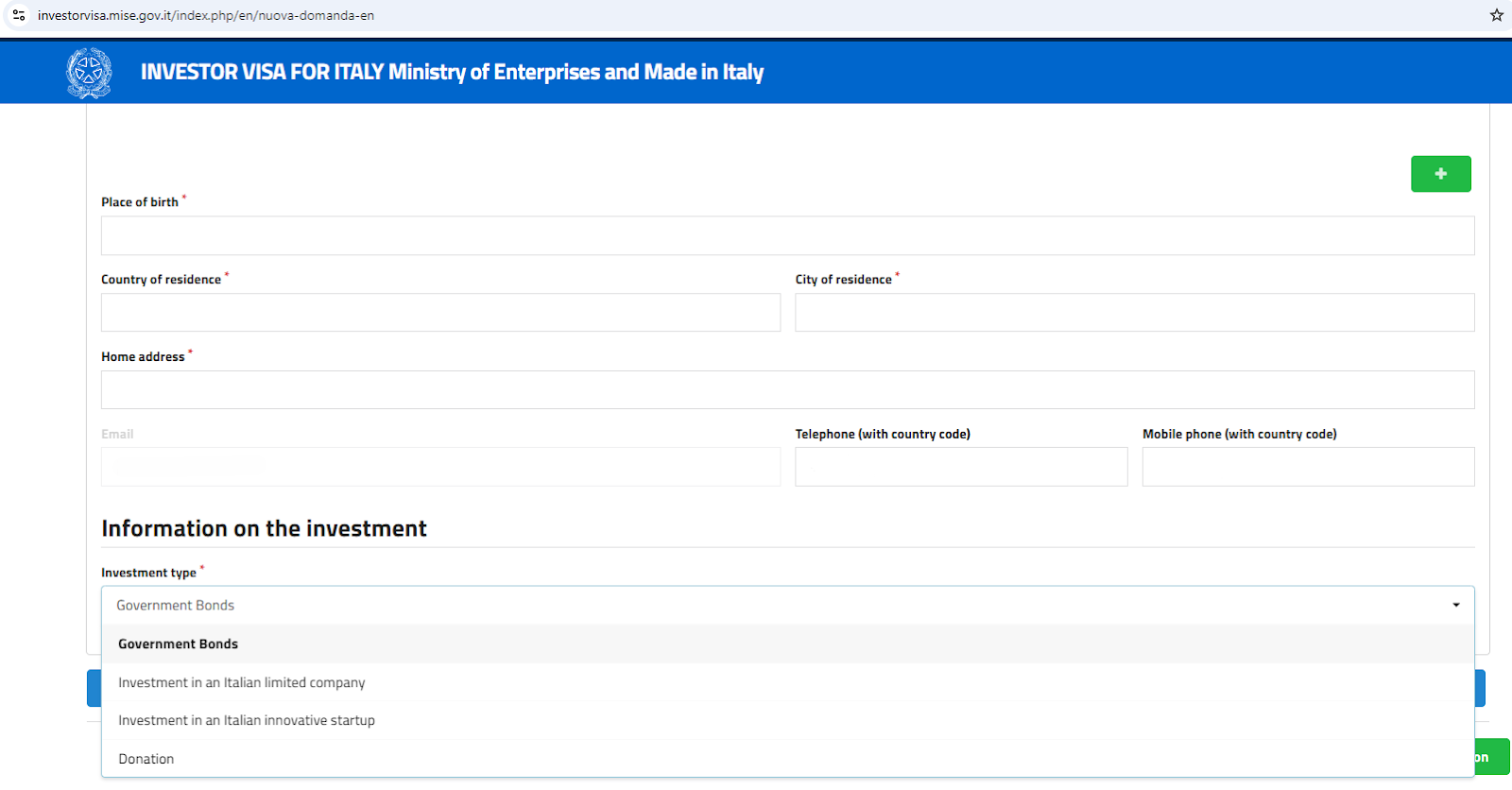
The Italy Investor Visa is submitted through the Italian government’s Ministry of Enterprises and Made in Italy user-friendly web portal.
You will also need to obtain an “Identity History Summary Check" from the Federal Bureau of Investigation (FBI). That ‘rap sheet’ will need to be included with your application.
Once submitted, your application undergoes a preliminary review by the Investor Visa Committee, which typically takes around 30 days.
This Identity History Summary and certain other documents would need to be apostilled by the U.S. Department of State in order to be accepted by the Italian authorities. This can take about 2-3 weeks to obtain.
The apostille is a certification from the U.S. Department of State or other relevant authority in your home state that authenticates documents for use officially in Italy, in accordance with the Hague Convention.
All of these apostilled documents as well as other documents uploaded to the portal must also be translated into Italian. Italy commonly accepts translations by certified translators. Immigration Diligence will connect you with a sworn translator recognized by your nearest Italian consulate. Once the document(s) are translated, have them notarized and attach a copy of the apostilled source document. We generally recommend saving one certified translation for the portal and one for in-person submission.
Our firm is based in Washington, D.C., making us uniquely advantaged to assist you with obtaining apostilles for your federal documents more quickly and efficiently than other services.
Once approved, your Nulla Osta certificate will be valid for six months. This will now allow you to proceed with submitting your Investor Visa application at your nearest Italian consulate in the United States.
You can refer to this list for the right consulate applicable to you:
|
Italian Consulate Name |
Address |
Region coverage |
|
Consular Office within the Embassy of Italy (Washington, D.C.) |
3000 Whitehaven Street NW, Washington, DC 20008 |
District of Columbia, Montgomery and Prince George's Counties (Maryland), Arlington and Fairfax Counties and Cities of Alexandria, Falls Church, and Fairfax (Virginia) |
|
Consulate General of Italy (New York) |
690 Park Avenue, New York, NY 10065 |
New York, Connecticut, and specific New Jersey counties (Bergen, Essex, Hudson, Hunterdon, Mercer, Middlesex, Monmouth, Morris, Passaic, Somerset, Sussex, Union, Warren), and Bermuda |
|
Consulate General of Italy (Boston) |
600 Atlantic Avenue, Boston, MA 02210 |
Maine, Massachusetts, New Hampshire, Rhode Island, Vermont |
|
Consulate General of Italy (Philadelphia) |
600 Chestnut Street, Suite 956, Philadelphia, PA 19106 |
Pennsylvania, Delaware, North Carolina, West Virginia, specific New Jersey counties (Atlantic, Burlington, Camden, Cape May, Cumberland, Gloucester, Ocean, Salem), and parts of Maryland and Virginia not covered by Embassy |
|
Consulate General of Italy (Chicago) |
500 North Michigan Avenue, Suite 1850, Chicago, IL 60611 |
Colorado, Illinois, Iowa, Kansas, Minnesota, Missouri, Nebraska, North Dakota, South Dakota, Wisconsin, Wyoming |
|
Consulate of Italy (Detroit) |
Buhle Building, 535 Griswold, Suite 1840, Detroit, MI 48226 |
Indiana, Kentucky, Michigan, Ohio, Tennessee |
|
Consulate General of Italy (Houston) |
1300 Post Oak Boulevard, Suite 660, Houston, TX 77056 |
Arkansas, Louisiana, Oklahoma, Texas |
|
Consulate General of Italy (Los Angeles) |
12424 Wilshire Boulevard, Suite 1400, Los Angeles, CA 90025 |
Arizona, New Mexico, Nevada, and specific California counties (Imperial, Kern, Los Angeles, Orange, Riverside, Santa Barbara, San Bernardino, San Diego, San Luis Obispo, Ventura) |
|
Consulate General of Italy (San Francisco) |
2590 Webster Street, San Francisco, CA 94115 |
Alaska, remaining California counties, Idaho, Montana, Oregon, Utah, Washington, Hawaii, and U.S. territories (Guam, Northern Mariana Islands, American Samoa, Wake Island, Midway Atoll, Johnston Atoll) |
|
Consulate General of Italy (Miami) |
4000 Ponce de León Boulevard, Suite 590, Coral Gables, FL 33146 |
Alabama, Florida, Georgia, Mississippi, South Carolina, and Caribbean territories (British Virgin Islands, Cayman Islands, Jamaica, Puerto Rico, St. Maarten, Turks and Caicos, U.S. Virgin Islands, The Bahamas) |
You will apply for the “Type D” long-stay visa at the Italian consulate with jurisdiction over your U.S. residence. The consulate will require the Nulla Osta plus the same supporting documents you uploaded to the portal in Step 2 of this guide. Consulate processing times and local fee schedules vary by office (expect several weeks to a few months).
This visa is valid for entry and stay in Italy for up to two years. The consulate provides instructions for what to do upon arrival in Italy, including applying for a residence permit (permesso di soggiorno) within eight days and completing the investment within the stipulated period.
At this point, we generally recommend investors obtain an Italian tax ID (codice fiscale). The Italian consulate can issue this on request, or your Italian lawyer can obtain it from the Agenzia delle Entrate (Italian equivalent of the IRS) with a passport copy and a simple authorization letter.
Before conducting any business in Italy or even opening any Italian bank account, you must obtain this Italian tax ID. This is an important step for the Italian golden visa.
As a reminder, you do not need to travel to Italy to initiate or submit the application for the Investor Visa/Nulla Osta. However, you do need to be physically present in Italy once the visa is granted in order to apply for the residence permit, complete fingerprinting, and finalize the investment.
It is advisable to prepare for this stage well in advance, as the subsequent months tend to be demanding for Investor Visa applicants and their families. The first eight days after entry along with the first three months require significant documentation and preparation; therefore, we recommend our clients have everything well-prepared ahead of their travel into Italy.
Within eight days of arrival in Italy, you are required to apply for a Permesso di Soggiorno per Investitori (Residence Permit) at the local police headquarters (Questura). This permit allows you legal stay and residency in Italy beyond the initial visa period.
Many Questura offices have an online booking system or a specific phone line for scheduling appointments. Booking in advance is important to avoid long waiting times and to ensure that your application is processed promptly. After arrival in Italy, you should schedule this appointment as soon as possible, ideally within the first eight days, to comply with Italian immigration law.
This step in the process involves providing biometric data and verifying your identity. At the Questura you’ll provide fingerprints and photos; you may be given immediate confirmation or a short receipt.
The Questura may take several weeks to process your application. During this time, you have legal residency rights.
Now, you will make your investment at the tier of your choice. You have three months from your arrival in Italy to make the approved investment as specified in your Nulla Osta application and visa.
It is critical to complete the investment within the timeframe required by the Nulla Osta and by the local authorities—industry practice is that investors should finalize transactions within 3 months of entry and retain documentary proof. This proof includes documentation such as bank SWIFT receipts, share certificates, escrow confirmations or donation receipts.
To prove maintenance of the investment for the Italian Golden Visa, it’s important to keep track of the evidence confirming that your investment remains active. Our legal partners in Italy will ensure that you obtain the proper documentation in order to prove that you have maintained your investment for the duration of your residence permit.
Note: In order to maintain and renew your Investor Visa, you must maintain your investment. If you “cash out,” you risk losing your residence rights in Italy. This is an important consideration for those that plan to not physically stay in Italy for the majority of the year.
Renewals are required every two years until you reach the 5-year mark of legal tax residence (physical presence in Italy for a minimum of 183 days per year). After five years of legal tax residence in Italy, you may apply for permanent residency.
Obtaining Permesso di Soggiorno UE per Soggiornanti di Lungo Periodo (Permanent Residency) in Italy gives you long-term security no longer tied to maintaining your investment, full freedom to live and work anywhere in the country, and expanded mobility across Europe. You gain broader access to Italy’s healthcare, education, and social services, stronger family rights, and the flexibility to change or liquidate your investments without affecting your status. It also positions you one step away from Italian citizenship, offering a powerful blend of stability, lifestyle benefits, and future optionality for global investors
After 10 years of legal tax residency, you may apply for Italian citizenship. Naturalization requires demonstrating integration and a knowledge of Italian at B1 level and a clean criminal record. As an Italian citizen, you gain rights to live, work, study and retire in any country in the EU, European Economic Area and Switzerland.
Italian authorities assess “effective residence.” To qualify for citizenship, avoid being absent for more than 8–10 months in any 5-year block. Long absences may restart your residency clock.